|
机器学会 “分步观察”|哈工大(深圳)× 复旦儿科联合攻关,破解自闭症AI早筛的隐藏瓶颈/Machines Learn to "Observe in Steps" | HIT (Shenzhen) × Fudan Pediatrics Join Forces to Crack the Hidden Bottleneck in Autism AI Early Screening时间:2026-11-09 【转载】自闭症谱系障碍(ASD)的早筛查、早干预,能够显著改善儿童长期发育结局。但在真实临床场景中,早筛工作长期面临现实困境: 金标准评估高度依赖资深临床医师的经验判断,主观差异难以避免,国内具备资质的专业人才缺口巨大。 近些年,计算机视觉、视频行为分析技术,为自闭症客观筛查带来新希望。不少研究聚焦识别孩子的社交手势、眼神反应等行为生物标志物,但有一个极易被忽视的隐性卡点:什么时候才是观察儿童反应的正确时间窗口?很多AI系统可以精准识别行为,却找不准该分析哪一段视频。窗口一旦偏移,再精妙的算法也如同在流沙上筑塔,分析结果失去临床可信度。 近日,哈尔滨工业大学(深圳)刘洪海教授团队与复旦大学附属儿科医院徐秀教授团队合作,在中国工程院Engineering集群分刊ENGINEERING Health and Rehabilitation Engineering上发表了题为“A Framework for Behavioral Biomarker Analysis via Action Segmentation in Early Autism Screening”的研究论文。该研究提出基于时间动作分割的自闭症早期筛查框架TAS²F(Temporal Action Segmentation-based Autism Early Screening Framework)。不再单纯检测孤立事件,而是完整解析医生与儿童的全部临床互动流程,自动锁定有效观测时段,为行为生物标志物的客观量化提供新方案。 Early screening and early intervention for Autism Spectrum Disorder (ASD) can significantly improve children's long-term developmental outcomes. Yet in real clinical settings, early screening has long been hampered by practical difficulties: the gold-standard assessment relies heavily on the experienced judgment of senior clinicians, where subjective variation is hard to avoid, and China faces a severe shortage of qualified professionals. In recent years, computer vision and video-based behavioral analysis have brought new hope to the objective screening of autism. Many studies have focused on identifying behavioral biomarkers such as children's social gestures and eye-contact responses. Yet there is an easily overlooked, hidden bottleneck: when is the right time window to observe a child's response? Many AI systems can recognize behaviors with precision, but they cannot pinpoint which segment of video should be analyzed. Once the window drifts, even the most sophisticated algorithm is like building a tower on quicksand—its analysis loses all clinical credibility. Recently, a team led by Professor Hong-Hai Liu of the Harbin Institute of Technology (Shenzhen) and a team led by Professor Xiu Xu of the Children's Hospital of Fudan University jointly published a research paper titled "A Framework for Behavioral Biomarker Analysis via Action Segmentation in Early Autism Screening" in ENGINEERING Health and Rehabilitation Engineering, a cluster sub-journal of Engineering (Chinese Academy of Engineering). The study proposes TAS²F (Temporal Action Segmentation-based Autism Early Screening Framework), an early autism screening framework grounded in temporal action segmentation. Rather than merely detecting isolated events, it fully parses the entire clinical interaction between doctor and child, automatically locks onto the valid observation window, and offers a new solution for the objective quantification of behavioral biomarkers.
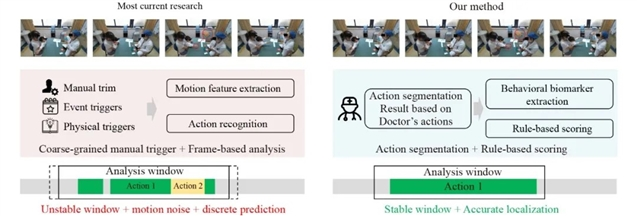
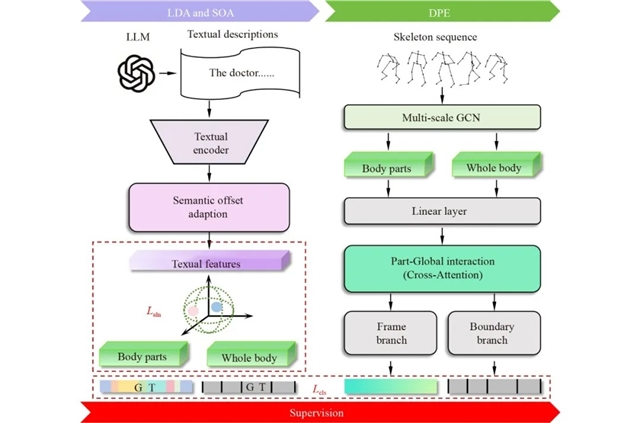
图1.传统机器辅助筛查范式与本研究TAS²F框架概念对比/Fig. 1. Conceptual comparison between the traditional machine-assisted screening paradigm and the TAS²F framework proposed in this study 旧方案的痛点:不稳定的分析窗口 传统机器辅助自闭症筛查流程,一般依靠人工剪辑视频、物理按键、语音识别等方式标记社交刺激的起始时刻。这种粗粒度触发方式存在明显短板:临床互动动作边界模糊,还存在各类环境噪声,很容易造成分析窗口偏移。系统会把无关动作、无效画面纳入计算,带来运动噪声与碎片化预测。 简单来说:标记的时间点错了,后续行为识别再准,结果也不可靠。 TAS²F框架转换了解决思路:不对单点事件做检测,而是把整套临床诊疗流程拆解为连续标准化动作片段,建立一套 “时间坐标系”。只有当医生完成刺激操作、进入规定的观察阶段,系统才启动对儿童行为的评估,得到稳定、精准的分析窗口。 研究选取自闭症筛查中两个核心协议开展验证: 表达性需求指向ENP:观察儿童是否使用手指指向物品表达需求,是早期沟通能力的关键标志; 回应性共同注意RJA:考察儿童能否跟随医生手势看向目标物体,共同注意缺陷是自闭症核心特征之一。 整套框架分为四大环节: 1.身份识别与特征提取:从视频中分离医生与儿童,提取医生人体骨架序列; 2.医生动作流解析、定位观察窗口:通过动作分割模型,自动切分出 “互动建立-施加刺激-观察反应” 完整流程,锁定合法观测时间段; 3.儿童行为计算:在划定窗口内,完成手势识别、头部姿态、视线方向、目标物体检测; 4.基于规则打分:依据临床协议规则,输出量化评分,为医生提供客观参考。 LAPS-AS:面向临床场景的骨架动作分割模型 框架的技术核心为语言辅助部分级分割模型LAPS-AS(Language-Assisted Part-level Segmentation),专门解决临床细粒度动作区分难题。临床场景里很多动作外观高度相似,例如 “放置泡泡瓶” 和 “放置发光小球”,普通模型极易混淆。 模型包含两大核心模块: 1.解耦姿态编码器DPE不把人体当作一个整体处理,独立建模头部、手部等局部身体部件运动,同时兼顾全身运动上下文,捕捉手指、转头这类对临床评估至关重要的细微动作,避免关键细节被平滑丢失。 2.语言辅助分布对齐LDA + 语义偏移适配器SOA引入大语言模型生成临床动作的文本语义描述,引导骨架运动特征学习;通过损失函数约束,让语义相近的动作特征在空间上聚拢,拉开不同动作的决策边界。考虑文本描述与真实人体运动天然存在差距,SOA适配器进一步弥合文本语义和真实运动之间的鸿沟。 The pain point of legacy approaches: unstable analysis windows Traditional machine-assisted autism screening workflows typically rely on manual video editing, physical buttons, or speech recognition to mark the onset moment of a social stimulus. This coarse-grained triggering method has clear shortcomings: the boundaries of clinical interaction actions are blurred, and various environmental noises are present, all of which easily cause the analysis window to drift. The system ends up folding irrelevant actions and invalid frames into its computations, producing motion noise and fragmented predictions. Put simply: if the marked timestamp is wrong, no matter how accurate the downstream behavior recognition is, the results remain unreliable. TAS²F reframes the solution: rather than detecting isolated single-point events, it decomposes the entire clinical diagnostic procedure into continuous, standardized action segments and establishes a "temporal coordinate system." Only when the doctor has completed the stimulus operation and entered the prescribed observation phase does the system begin assessing the child's behavior—thereby obtaining a stable, precise analysis window. The study selected two core protocols in autism screening for validation: Expressive Need Pointing (ENP): observing whether the child uses finger pointing to express needs for an object—a key marker of early communicative ability; Responsive Joint Attention (RJA): examining whether the child can follow the doctor's gestures to look at a target object; deficits in joint attention are among the core characteristics of autism. The overall framework consists of four stages: Identity recognition and feature extraction: separate the doctor and child from the video and extract the doctor's skeletal sequence. Doctor action-stream parsing and observation-window localization: using an action segmentation model to automatically cut out the complete "interaction establishment → stimulus delivery → response observation" flow and lock onto the valid observation time segment. Child behavior computation: within the delineated window, perform gesture recognition, head-pose estimation, gaze-direction analysis, and target-object detection. Rule-based scoring: according to clinical protocol rules, output a quantitative score to provide the doctor with an objective reference. LAPS-AS: a skeleton action segmentation model for clinical scenarios The technical core of the framework is the Language-Assisted Part-level Segmentation model, LAPS-AS, which specifically addresses the challenge of fine-grained action discrimination in clinical settings. In clinical scenarios, many actions look highly similar in appearance—for example, "placing a bubble bottle" versus "placing a glowing ball"—which ordinary models easily confuse. The model comprises two core modules: Decoupled Pose Encoder (DPE): instead of treating the human body as a single whole, it independently models the movements of local body parts such as the head and hands, while also incorporating full-body motion context. This captures subtle actions crucial to clinical assessment—such as finger movements and head turns—and prevents key details from being smoothed away and lost. Language-Assisted Distribution Alignment (LDA) + Semantic Offset Adapter (SOA): LDA introduces a large language model to generate textual semantic descriptions of clinical actions, guiding the learning of skeletal motion features; through a loss-function constraint, it pulls semantically similar action features closer together in space while widening the decision boundaries between different actions. Since textual descriptions and real human motion are naturally discrepant, the SOA adapter further bridges the gap between text semantics and actual motion.
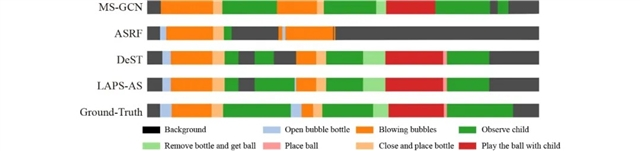
图2.LAPS-AS模型架构示意图,融合骨架运动特征与大模型语义引导/Fig. 2. Schematic of the LAPS-AS model architecture, integrating skeletal motion features with large-model semantic guidance 临床数据集与实验结果 研究依托复旦大学附属儿科医院,搭建真实临床数据集:包含48名受试儿童(25名ASD确诊,23名典型发育),共计96段临床筛查录像,总时长超230分钟,全部实验通过医院伦理委员会审批。 分割性能 · ENP协议(9类动作)帧级准确率:86.6% · RJA协议(2类动作)帧级准确率:99.0% 定性可视化结果可以直观看到,对比MS-GCN、ASRF、DeST等主流骨架分割基线,LAPS-AS输出的动作片段边界更加贴合人工标注真值,减少过度分割、碎片化预测问题。 Clinical dataset and experimental results Relying on the Children's Hospital of Fudan University, the study built a real clinical dataset: it comprises 48 participant children (25 diagnosed with ASD and 23 typically developing), for a total of 96 clinical screening recordings exceeding 230 minutes in duration. All experiments were approved by the hospital's ethics committee. Segmentation performance ENP protocol (9 action classes) — frame-level accuracy: 86.6% RJA protocol (2 action classes) — frame-level accuracy: 99.0% The qualitative visualization results show intuitively that, compared with mainstream skeleton-segmentation baselines such as MS-GCN, ASRF, and DeST, the action-segment boundaries produced by LAPS-AS align more closely with the human-annotated ground truth, reducing problems of over-segmentation and fragmented prediction.
图3.ENP协议下不同模型时间动作分割结果定性对比/Fig. 3. Qualitative comparison of temporal action segmentation results across different models under the ENP protocol 最关键:评分一致性 把模型自动分割得到的评分,和专家人工精准分割标注的评分做比对: · ENP协议评分一致性:82.1% · RJA协议评分一致性:93.6% 结果解读:RJA任务仅判断头部视线跟随,视觉信号简单稳定,一致性更高;ENP需要同时识别手势形态、指向方位、眼神接触,容易受手部遮挡、儿童快速动作干扰,是系统主要误差来源。 消融实验证明,LDA语言辅助模块对整体性能提升贡献最大,证明把临床先验语义知识注入模型,对医疗场景算法至关重要。 临床意义 1.替代人工剪辑,释放科研人力。过去处理临床视频需要专家逐段剪辑标记,成本极高。TAS²F可以自动完成时间窗口定位,支持大批量视频的批量分析,加速自闭症行为表型相关研究。 2.作为临床辅助决策工具,而非替代医生诊断。该框架输出量化评分,给临床医师提供客观行为参考,缓解专业人员不足的压力,适配常规筛查工作流。 3.延伸应用潜力广阔。除辅助筛查外,这套技术还可用于:医生标准化筛查操作的质控培训;长期随访中客观追踪干预康复效果;挖掘人眼难以捕捉的细微行为生物标志物。 很多技术研发将重心放在“如何识别孩子的异常行为”,但这项工作提醒我们:在追求更聪明的识别模型之前,先要保证我们用于分析的时间窗口本身是干净、准确的。 TAS²F并非一套可以直接落地的最终产品,但它给出了一条务实路径:从临床流程本身出发,用时间动作分割搭建稳定的分析基座,弥合视频AI技术与真实自闭症早筛临床之间的鸿沟,为下一代客观计算机辅助筛查工具打下基础。 The most critical point: scoring consistency The scores derived from the model's automatic segmentation were compared against those from experts' precise manual segmentation annotations: ENP protocol — scoring consistency: 82.1% RJA protocol — scoring consistency: 93.6% Interpretation of results: The RJA task only judges head/gaze following, whose visual signal is simple and stable, yielding higher consistency; ENP must simultaneously recognize gesture shape, pointing direction, and eye contact, and is easily disturbed by hand occlusions and the child's rapid movements—making it the system's primary source of error. Ablation studies demonstrate that the LDA language-assistance module contributes the most to overall performance gains, confirming that injecting clinical prior semantic knowledge into the model is crucial for algorithms in medical scenarios. Clinical significance Replacing manual editing and freeing up research manpower. Processing clinical video previously required experts to clip and label footage segment by segment at extremely high cost. TAS²F can automatically localize the time window and support batch analysis of large video volumes, accelerating research on autism behavioral phenotypes. Serving as a clinical auxiliary decision-making tool, not a replacement for the doctor's diagnosis. The framework outputs quantitative scores that give clinicians an objective behavioral reference, easing the pressure of insufficient specialist staffing and fitting into routine screening workflows. Broad potential for extended applications. Beyond assistive screening, this technology can also be used for: quality-control training in physicians' standardized screening procedures; objective tracking of intervention and rehabilitation outcomes in long-term follow-up; and uncovering subtle behavioral biomarkers that are hard for the human eye to capture. Many technology efforts focus on "how to recognize the child's abnormal behaviors," but this work reminds us: before pursuing ever-smarter recognition models, we must first ensure that the time window we analyze is itself clean and accurate. TAS²F is not a final product ready for immediate deployment, but it charts a pragmatic path: starting from the clinical procedure itself, it uses temporal action segmentation to build a stable analysis foundation, bridging the gap between video-AI technology and real-world autism early-screening practice, and laying the groundwork for the next generation of objective computer-assisted screening tools. |